Deno’s Garden

Ranunculus illyricus

Illyrian Buttercup
Family RanunculaceaeGenus Ranunculus

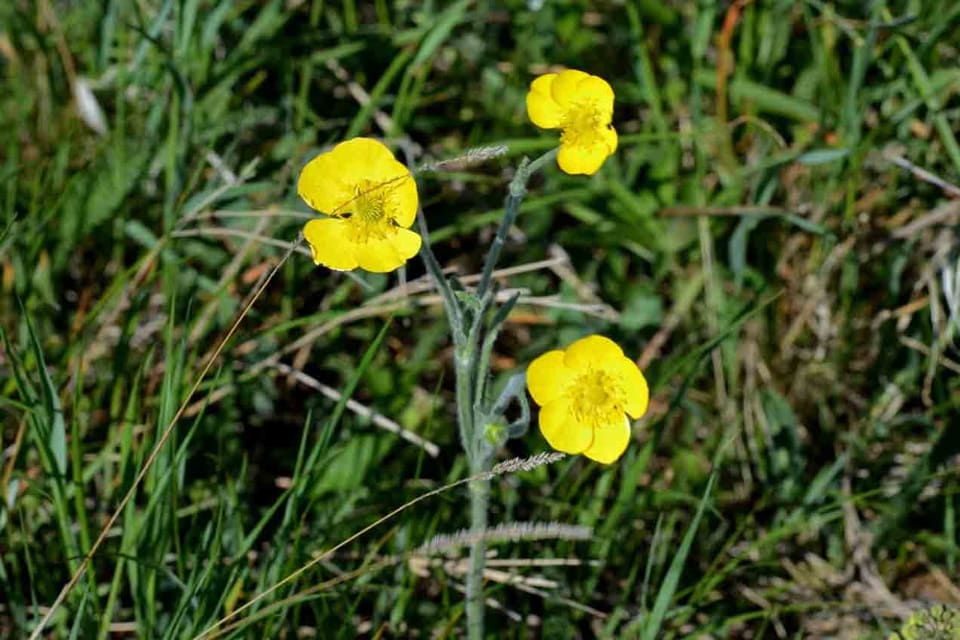
Yellow buttercups among grass, the leaves narrow and silvery
FlowerRadio Tonreg from Vienna, AustriaCC BY 2.0

About the plant

What it is and where it grows — not part of any germination protocol.

Toxicity
Poisonous to cattle, goats, horses. All parts. Protoanemonin. Stated for Ranunculus spp.

Toxicity is noted only where a source states it. No note here is not a finding of safety.

Source: Plants Poisonous to Livestock — Cornell University Department of Animal Science.

This source reports three treatments. All are shown.

Protocol 1

DerivedN. C. Deno, 1993

Difficulty High Rated by us, not by the source.

Start around February 15, 2027 for a May 3 last frost.

  1. Cold moist stratification

    Temperature: 40°F 4°C Light: either

No stated waiting before sowing. Then 49 days to germinate.

8% germination in 49 days.

The best of three, and that is 8%. Neither light nor GA-3 changed anything.

This source doesn't state how long.

Seed Germination Theory and Practice, 2nd ed. — N. C. Deno, 1993 · Ch. 20, RanunculusPublic domain
Show the original text
Ranunculus (Ranunculaceae). Germination was remarkably varied A. illyricus germ. 70D(6% in 3-6 w)-40(6%) and 40(8% in 7th w). Light or GA-3 had no effect. Seeds placed outdoors in November germ. 1/26 in April.
Seed Germination Theory and Practice, 2nd ed., Ch. 20, Ranunculus. Quoted exactly. Every value on this card comes from this record, except the difficulty rating, which is ours; the step names come from a fixed list.

Protocol 2

DerivedN. C. Deno, 1993

Difficulty High Rated by us, not by the source.

Start around November 24, 2026 for a May 3 last frost.

  1. Warm moist stratification

    Duration: 90 daysTemperature: 70°F 21°C Light: either

    6%, over 3-6 weeks. Deno gives no length for this period; three months is his standard cycle.

  2. Cold moist stratification

    Temperature: 40°F 4°C

    A further 6%.

about 3 months from start to sowing. Then 42 days to germinate.

6% germination in 21–42 days.

6% at 70, then 6% more in the cold that follows.

This source doesn't state how long.

Seed Germination Theory and Practice, 2nd ed. — N. C. Deno, 1993 · Ch. 20, RanunculusPublic domain
Show the original text
Ranunculus (Ranunculaceae). Germination was remarkably varied A. illyricus germ. 70D(6% in 3-6 w)-40(6%) and 40(8% in 7th w). Light or GA-3 had no effect. Seeds placed outdoors in November germ. 1/26 in April.
Seed Germination Theory and Practice, 2nd ed., Ch. 20, Ranunculus. Quoted exactly. Every value on this card comes from this record, except the difficulty rating, which is ours; the step names come from a fixed list.

Protocol 3

DerivedN. C. Deno, 1993

Difficulty Very high Rated by us, not by the source.

Sow around November 2026 — a date the source gives, not one counted back from a May 3 last frost.

  1. Sow outdoors and leave it

    Placed outdoors in November; one up in April.

No stated waiting before sowing. Then 150 days to germinate.

4% germination in 150 days.

One seed of twenty-six. Outdoors is the worst of the three routes.

This source doesn't state how long.

Seed Germination Theory and Practice, 2nd ed. — N. C. Deno, 1993 · Ch. 20, RanunculusPublic domain
Show the original text
Ranunculus (Ranunculaceae). Germination was remarkably varied A. illyricus germ. 70D(6% in 3-6 w)-40(6%) and 40(8% in 7th w). Light or GA-3 had no effect. Seeds placed outdoors in November germ. 1/26 in April.
Seed Germination Theory and Practice, 2nd ed., Ch. 20, Ranunculus. Quoted exactly. Every value on this card comes from this record, except the difficulty rating, which is ours; the step names come from a fixed list.