Deno’s Garden

Balsamorhiza sagittata

Arrowleaf Balsamroot · Arrow-leaved Balsamroot
Family AsteraceaeGenus Balsamorhiza

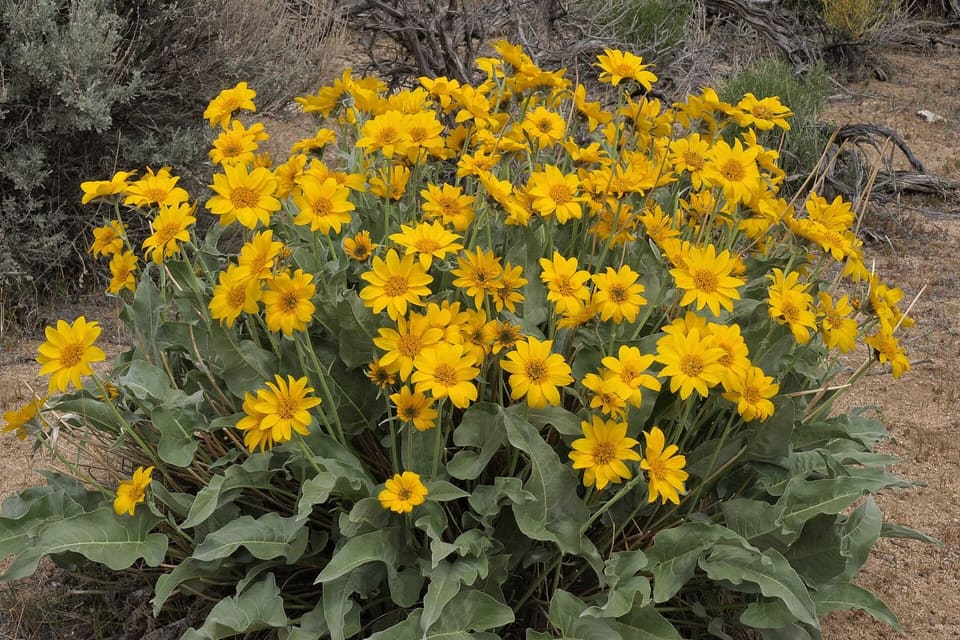
A mass of yellow daisies above large arrow-shaped leaves
FlowerJim Morefield from Nevada, USACC BY-SA 2.0

About the plant

What it is and where it grows — not part of any germination protocol.

The plant

Habit
Perennial, Forb/herbPLANTS Database
Height
2.0 ftPLANTS Database
Flower
YellowPLANTS Database
Blooms
Late SpringPLANTS Database
Native range
North AmericaGBIF Backbone Taxonomy
Native range
Canada, lower 48 statesPLANTS Database

Growing conditions

Sun
Shade tolerance: Medium
Moisture
Moisture use: Medium

Toxicity is noted only where a source states it. No note here is not a finding of safety.

Sources: PLANTS Database — USDA NRCS; GBIF Backbone Taxonomy — Global Biodiversity Information Facility.

This source reports two treatments. Both are shown.

Protocol 1

DerivedN. C. Deno, 1993

Difficulty Moderate Rated by us, not by the source.

Start around March 15, 2027 for a May 3 last frost.

  1. Gibberellic acid soak

  2. Sow and cover

    Temperature: 70°F 21°C

No stated waiting before sowing. Then 21 days to germinate.

22% germination in 21 days.

Seed Germination Theory and Practice, 2nd ed. — N. C. Deno, 1993 · Ch. 20, BalsamorhizaPublic domain
Show the original text
B. sagittata germ. 70(2/9 in 3rd w) if treated with GA-3 and 70(0/7) if untreated. It is possible that the sample treated with GA-3 contained the only two viable seeds. In any event the seedlings were normal and healthy.
Seed Germination Theory and Practice, 2nd ed., Ch. 20, Balsamorhiza. Quoted exactly. Every value on this card comes from this record, except the difficulty rating, which is ours; the step names come from a fixed list.

Protocol 2

DerivedN. C. Deno, 1993
  1. Sow and cover

    Temperature: 70°F 21°C

No stated waiting before sowing.

0% germination.

Seed Germination Theory and Practice, 2nd ed. — N. C. Deno, 1993 · Ch. 20, BalsamorhizaPublic domain
Show the original text
B. sagittata germ. 70(2/9 in 3rd w) if treated with GA-3 and 70(0/7) if untreated. It is possible that the sample treated with GA-3 contained the only two viable seeds. In any event the seedlings were normal and healthy.
Seed Germination Theory and Practice, 2nd ed., Ch. 20, Balsamorhiza. Quoted exactly. Every value on this card comes from this record; the step names come from a fixed list.