Deno’s GardenMy Garden

Streptopus lanceolatus

Genus Streptopus

Also published as Streptopus roseus. You are in the right place.

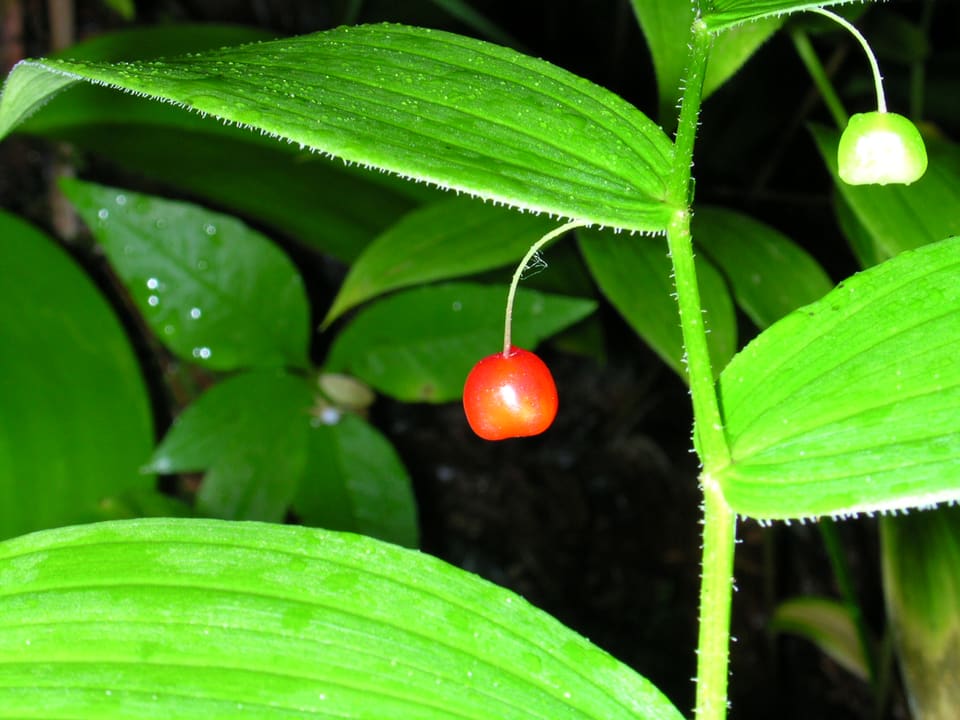
A single scarlet berry hanging on a fine stalk beneath an arching stem of broad ribbed leaves, with a white one behind.
FruitSuperior National ForestCC BY 2.0

Two sources report 4 treatments between them. All are shown.

Protocol 1

DerivedN. C. Deno, 1998

Difficulty High Rated by us, not by the source.

Start around September 17, 2027 for a May 3 last frost. Too late for spring 2027 — that needed starting on September 16, 2026.

  1. Cold moist stratification

    Duration: 90 daysTemperature: 40°F 4°C

  2. Warm moist stratification

    Duration: 90 daysTemperature: 70°F 21°C Light: dark

  3. Cold moist stratification

    Duration: 90 daysTemperature: 40°F 4°C

  4. Warm moist stratification

    Duration: 90 daysTemperature: 70°F 21°C Light: dark

    1/4 germinated in this phase.

Steps after step 2 run on after germination.

about 6 months from start to sowing. Then 21 days to germinate.

25% germination in 21 days.

Seed Germination Theory and Practice, 2nd Supplement — N. C. Deno, 1998 · 2nd Supplement, Streptopus p. 63Public domain
Show the original text
Streptopus (Liliaceae). S. rosea data is now more complete. Seeds germ. 70D-40-70D(2/6 on 8th d) and 40-70D(1/4 in 3rd w)-40-70D(1/4 on 7th d).
Seed Germination Theory and Practice, 2nd Supplement, 2nd Supplement, Streptopus p. 63. Quoted exactly. Every value on this card comes from this record, except the difficulty rating, which is ours; the step names come from a fixed list.

Protocol 2

DerivedN. C. Deno, 1998

Difficulty High Rated by us, not by the source.

Start around July 2, 2027 for a May 3 last frost. Too late for spring 2027 — that needed starting on July 1, 2026.

  1. Warm moist stratification

    Duration: 90 daysTemperature: 70°F 21°C Light: dark

  2. Cold moist stratification

    Duration: 90 daysTemperature: 40°F 4°C

  3. Warm moist stratification

    Duration: 90 daysTemperature: 70°F 21°C Light: dark

about 9 months from start to sowing. Then 8 days to germinate.

33% germination in 8 days.

Seed Germination Theory and Practice, 2nd Supplement — N. C. Deno, 1998 · 2nd Supplement, Streptopus p. 63Public domain
Show the original text
Streptopus (Liliaceae). S. rosea data is now more complete. Seeds germ. 70D-40-70D(2/6 on 8th d) and 40-70D(1/4 in 3rd w)-40-70D(1/4 on 7th d).
Seed Germination Theory and Practice, 2nd Supplement, 2nd Supplement, Streptopus p. 63. Quoted exactly. Every value on this card comes from this record, except the difficulty rating, which is ours; the step names come from a fixed list.

Protocol 3

DerivedN. C. Deno, 1996
  1. Cold moist stratification

    Temperature: 40°F 4°C

No stated waiting before sowing.

0% germination.

Nothing germinated at 40.

This source doesn't state how long.

Seed Germination Theory and Practice, 1st Supplement — N. C. Deno, 1996 · 1st Supplement, Streptopus p. 79Public domain
Show the original text
Streptopus (Liliaceae). S. rosea germ. 70D-40-70D(2/6 on 8th d) and none in 40 or OT. Treatment with GA-3 after a y of moist treatments failed to initiate germination.
Seed Germination Theory and Practice, 1st Supplement, 1st Supplement, Streptopus p. 79. Quoted exactly. Every value on this card comes from this record; the step names come from a fixed list.

Protocol 4

DerivedN. C. Deno, 1996

Difficulty Very high Rated by us, not by the source.

  1. Sow outdoors and leave it

    Nothing germinated outdoors.

No stated waiting before sowing.

0% germination.

This source doesn't state how long.

Seed Germination Theory and Practice, 1st Supplement — N. C. Deno, 1996 · 1st Supplement, Streptopus p. 79Public domain
Show the original text
Streptopus (Liliaceae). S. rosea germ. 70D-40-70D(2/6 on 8th d) and none in 40 or OT. Treatment with GA-3 after a y of moist treatments failed to initiate germination.
Seed Germination Theory and Practice, 1st Supplement, 1st Supplement, Streptopus p. 79. Quoted exactly. Every value on this card comes from this record, except the difficulty rating, which is ours; the step names come from a fixed list.

Add to My Garden

View species page