Deno’s GardenMy Garden

Oreomecon alpina

Austrian Poppy · Rhaetian Poppy · Alpine Poppy · Dwarf Poppy

Genus Oreomecon

Also published as Papaver alpinum, Papaver julicum. You are in the right place.

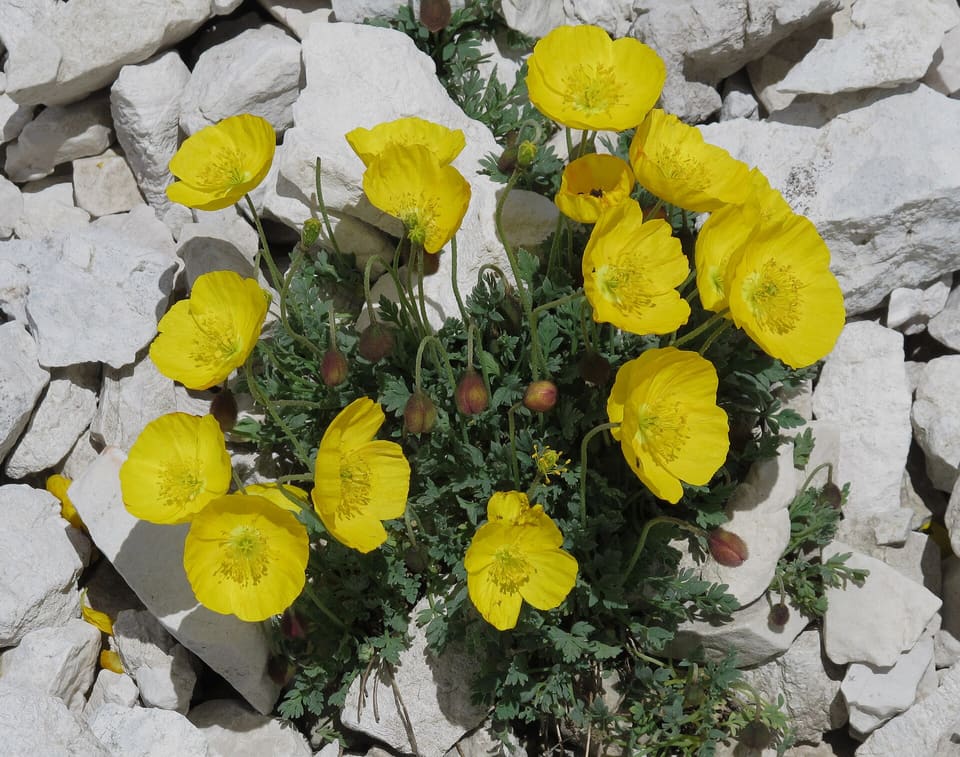
A clump of yellow poppies on thin stems above ferny grey-green leaves, growing out of a bed of white limestone rubble.
The whole plantRobert Flogaus-FaustCC BY 4.0

About the plant

What it is and where it grows — not part of any germination protocol.

Habit
Perennial, Forb/herbPLANTS Database
Native range
Native to the lower 48 statesPLANTS Database

Toxicity is noted only where a source states it. No note here is not a finding of safety.

Source: PLANTS Database — USDA NRCS.

This source reports 4 treatments. All are shown.

Protocol 1

DerivedN. C. Deno, 1996

Difficulty Low Rated by us, not by the source.

Start around March 26, 2027 for a May 3 last frost.

  1. Gibberellic acid soak

  2. Sow and cover

    Temperature: 70°F 21°C

No stated waiting before sowing. Then 10 days to germinate.

100% germination in 6–10 days.

Seed Germination Theory and Practice, 1st Supplement — N. C. Deno, 1996 · 1st Supplement, Papaver p. 63Public domain
Show the original text
Papaver (Papaveraceae). KW reports that many species show no sign of dying after 5 y of DS. P. julicum germ. 70 GA-3(100% in 6-10 d) and 70D(50% in 4-10 d).
Seed Germination Theory and Practice, 1st Supplement, 1st Supplement, Papaver p. 63. Quoted exactly. Every value on this card comes from this record, except the difficulty rating, which is ours; the step names come from a fixed list.

Protocol 2

DerivedN. C. Deno, 1996

Difficulty Low Rated by us, not by the source.

Start around March 15, 2027 for a May 3 last frost.

  1. Gibberellic acid soak

  2. Sow and cover

    Temperature: 70°F 21°C

No stated waiting before sowing. Germination time not stated; 21 days assumed.

100% germination.

Seed Germination Theory and Practice, 1st Supplement — N. C. Deno, 1996 · 1st Supplement, Papaver p. 63Public domain
Show the original text
Papaver (Papaveraceae). KW reports that many species show no sign of dying after 5 y of DS. P. pyrenaicum v. rhaeticum germ. 70 GA-3(100%) and 70D(44%) both in 2nd w.
Seed Germination Theory and Practice, 1st Supplement, 1st Supplement, Papaver p. 63. Quoted exactly. Every value on this card comes from this record, except the difficulty rating, which is ours; the step names come from a fixed list.

Protocol 3

DerivedN. C. Deno, 1996

Difficulty Moderate Rated by us, not by the source.

Start around March 26, 2027 for a May 3 last frost.

  1. Sow and cover

    Temperature: 70°F 21°C Light: dark

No stated waiting before sowing. Then 10 days to germinate.

50% germination in 4–10 days.

Seed Germination Theory and Practice, 1st Supplement — N. C. Deno, 1996 · 1st Supplement, Papaver p. 63Public domain
Show the original text
Papaver (Papaveraceae). KW reports that many species show no sign of dying after 5 y of DS. P. julicum germ. 70 GA-3(100% in 6-10 d) and 70D(50% in 4-10 d).
Seed Germination Theory and Practice, 1st Supplement, 1st Supplement, Papaver p. 63. Quoted exactly. Every value on this card comes from this record, except the difficulty rating, which is ours; the step names come from a fixed list.

Protocol 4

DerivedN. C. Deno, 1996

Difficulty Moderate Rated by us, not by the source.

Start around March 15, 2027 for a May 3 last frost.

  1. Sow and cover

    Temperature: 70°F 21°C Light: dark

No stated waiting before sowing. Germination time not stated; 21 days assumed.

44% germination.

Seed Germination Theory and Practice, 1st Supplement — N. C. Deno, 1996 · 1st Supplement, Papaver p. 63Public domain
Show the original text
Papaver (Papaveraceae). KW reports that many species show no sign of dying after 5 y of DS. P. pyrenaicum v. rhaeticum germ. 70 GA-3(100%) and 70D(44%) both in 2nd w.
Seed Germination Theory and Practice, 1st Supplement, 1st Supplement, Papaver p. 63. Quoted exactly. Every value on this card comes from this record, except the difficulty rating, which is ours; the step names come from a fixed list.

Add to My Garden

View species page